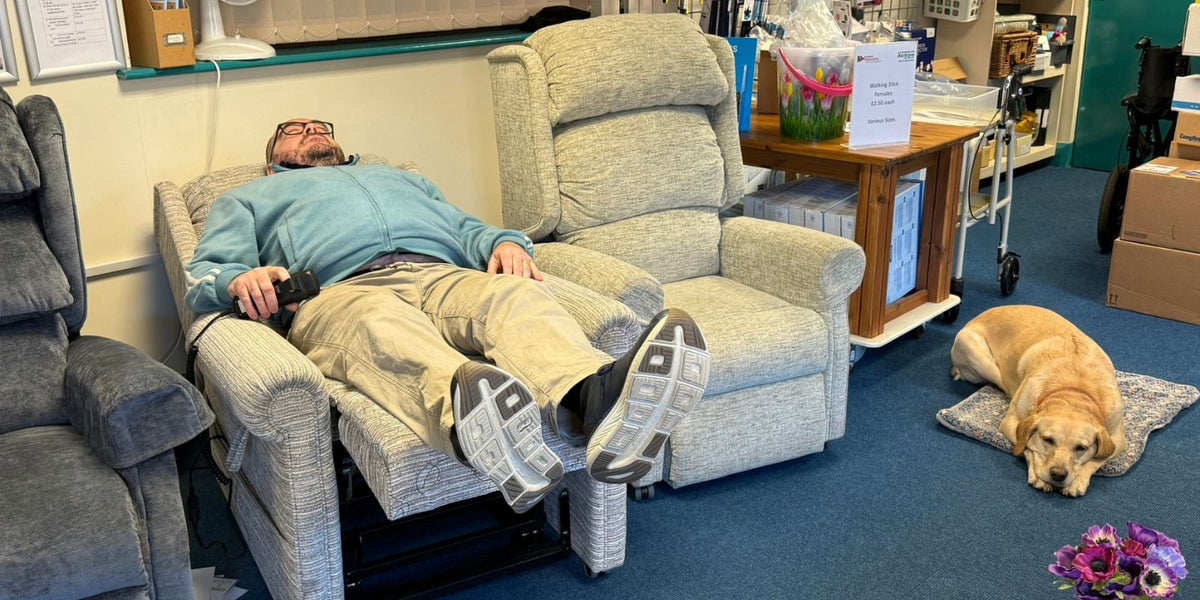
A riser recliner is a powered armchair that tilts forward to help you stand, lowers you gently to sit and reclines so you can rest with your legs up. Get the right one and it can last over 10 years. Get the wrong size and it won't last at all.
Browse all our riser recliner chairs.
Why the right size matters most
Before I worked at Active Mobility, my husband Mike bought a second-hand riser chair. It wasn't big enough. He replaced it with one from a cheap mobility shop, and that didn't last either.
Working here taught me why. A riser chair has to match the user's size and weight rating. The chair Mike got from us, properly fitted, lasted him over 10 years. (Tracy, Managing Director)
In the right chair you can sit straight back into it without wriggling. Your feet rest flat on the floor, there's a small gap behind your knees, and your arms rest on the arms with your shoulders down. If you have to shuffle back to reach the backrest, the seat is too deep.
We recently fitted a customer in a Dallux petite. The seat height was right, but the seat depth is the same as the standard size, and she had about a 2-inch gap behind her back. In a Cosi petite, which has a shorter seat, she was visibly more comfortable.
How we measure you
| Measurement | How we take it |
|---|---|
| Seat height | Heel to the back of the knee, in the shoes or slippers you wear at home |
| Seat depth | Back of the bottom to the back of the knee, leaving about two fingers' gap |
| Seat width | Widest point of the hips, plus room to slide a flat hand down each side |
| Arm height | Elbow to the seat, sitting upright with shoulders relaxed |
| Back height | Seat to the top of the head |
If a measurement falls between sizes, we go up rather than down. The seat cushion settles a little as you sit, and a chair that's too small puts strain on the mechanism. Wider isn't always better, though. If the arms are too far apart you'll lean to one side, and you lose the leverage you need to push yourself up.
Made-to-measure chairs, such as Rise & Recline's, can change the seat height in one-inch steps (usually from 16 or 18 inches up to 21 or 22) and come in 18, 20 or 22 inch widths. Some back styles have loose cushions that we can move up, down, in or out on the day to get the fit right.
Which motor do you need?
| Motor | What it does | Best for |
|---|---|---|
| Standard dual motor | Back and footrest move separately, seat stays flat | Everyday comfort, reading or TV with your legs up |
| Single motor tilt-in-space | Whole seat tips back as one, legs rise above the hips | Swollen ankles, circulation, fragile skin |
| Dual motor tilt-in-space | Tilt-in-space plus a separate back | Long periods of sitting, changing needs |
| Triple motor | Separate legs, back and tilt | Complex needs, very heavy or swollen legs |
| Quad motor | Dual tilt-in-space plus powered head cushion and lumbar | Bad backs, watching TV lying back |
Tilt-in-space is worth considering on most chairs. Because the whole seat tilts, your jumper doesn't get pulled up as you recline, and you can shift where the pressure sits on your body. There's more detail, including user weights, in the different riser recliner motors explained.
Check the user weight and the leg lift
Standard chairs usually take 20 or 25 stone, and bariatric chairs go much higher. Each mechanism also has a limit on how much weight the footrest can lift. If your legs are heavy or swollen, you may need a stronger leg lift even if your overall weight is well inside the limit.
Backs and arms
- Waterfall back: three loose cushions that flow over the top. They can be moved to suit a shorter or taller person, so it's very adjustable.
- Lateral back: side wings that hug you and keep you upright and central.
- Thoracic back: the lateral cushion turned the other way up, so the support sits higher. It suits people who can't sit fully back because of their shape.
- Scroll arm: the traditional rolled arm.
- Knuckle arm: a wooden handle at the front to grip, good if you have arthritis in your hands. A padded version gives the grip with a more modern look.
Features worth looking for
- Battery backup: in a power cut, a chair without one won't move, and you can be stuck in it. A backup runs it slower, but it runs. Have the battery checked yearly and replaced when needed
- Powered lumbar support: great if you have a bad back. Not every chair has it
- Moving head cushion: it comes forward as you lie back, so you can still see the room and watch the telly
- Heat and massage: heat is lovely for arthritis
- Arm caps: removable covers that protect the arms, which get the most wear
- Fabric: soft fabric, faux leather, or wipe-clean and waterproof
The chairs we recommend
We sell the Dallux Nevis and Cosi ranges, plus Repose and Rise & Recline, and bespoke made-to-measure chairs. Cosi and Dallux usually come in three sizes. On the Dallux Nevis, go for the version with powered lumbar and head cushion, such as the Nevis four motor. Chairs on our website cost from £795 to £1,995. See how much a rise recliner chair costs, and find out how Rise & Recline make their chairs.
Mistakes that break riser chairs
- Pushing it against the wall. If the back hits the wall when it reclines and you keep pressing the button, the frame twists and the chair jams or stops working. Cleaners often push chairs back and forget to pull them forward. We can see the marks on the wall.
- Blocking the footrest. A coffee table in the way, or something stuck underneath, can twist the frame just like a wall. Keep the area clear, and check the dog or cat isn't under there.
- Dropping into it. Leave the chair raised when you get up, so it's ready to lower you back down. Dropping into a lowered chair, day after day, breaks it.
- No battery backup. A power cut shouldn't leave you stuck in your chair.
More in riser recliner chair problems and how to avoid them.
Try one at home
We offer free home assessments within 75 miles of our Stratford-upon-Avon showroom. We'll measure you and your room and bring chairs to try. Please call first so we have the right chairs ready: 01789 339 738.
Frequently asked questions
Single or dual motor?
Single is simple and good value. Dual lets you raise your legs while sitting upright.
What size do I need?
It depends on your height, weight and leg length. We measure you at a free home assessment.
How far from the wall should it be?
Even a wall hugger, which moves forward as it reclines, needs at least 16 inches behind it. A dual motor chair needs around 28 inches, roughly as much as the back is tall, and a taller back needs more. When we deliver, we recline it all the way to check.
Can I sleep in my riser chair?
Riser chairs aren't designed to be slept in overnight. A nap is fine, but they aren't a replacement for a bed.
How long does delivery take?
About 3 weeks for most standard chairs, and usually 15 to 20 working days for Rise & Recline made-to-measure chairs.
Do you deliver and set up?
Yes. We deliver, set up, show you the handset and can take away your old chair.