A made-to-measure wheelchair, whether it's an active wheelchair you push yourself or an electric wheelchair (also known as a powerchair), is built around one person. If you use it all day, every day, a good fit is what keeps you comfortable, supported and independent.
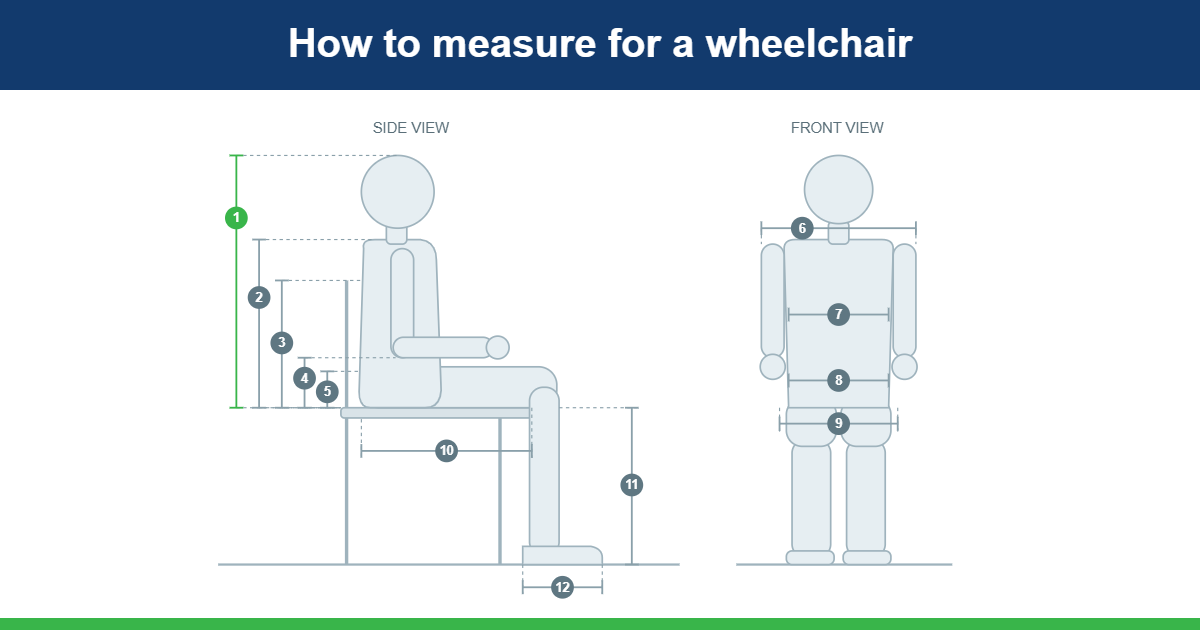
Before a chair is ordered, the manufacturer needs a set of body measurements. We take these at your assessment, but you can take them yourself at home first using our wheelchair measuring guide. It shows each measurement on a diagram and builds a list you can send to us.
How to measure
- Sit upright on a firm, flat chair, or in your current wheelchair if you use one all day.
- If you normally sit on a cushion, sit on it while you measure, and tell us when you send your figures.
- Keep your usual clothes and shoes on, and your feet flat.
- Use a metal tape measure, and ask someone to hold it level for you.
What each measurement decides
Each measurement links to a part of the chair. Getting them right is what makes the chair feel like it was made for you, because it was.
Seat width
Measured across the widest point when you're sitting, usually your hips or thighs, plus hip width across the hips themselves. Too narrow and the chair rubs and presses on your hips. Too wide and you lean to one side, and on an active wheelchair the wheels end up further out, so pushing is harder work for your shoulders.
Seat depth
Your sitting depth, from the back of your bottom to the back of your knee. This sets how long the seat is. Too long and it presses behind your knees and pushes you into a slump. Too short and your thighs aren't supported, so more of your weight sits on a smaller area.
Seat height and footplates
Your lower leg length, from the back of the knee down to the floor with shoes on, and your foot length. Together these set the seat height and where the footplates go, so your feet are supported and your thighs rest evenly on the seat.
Back height and back width
Top of pelvis, underarm and shoulder to seat, plus your trunk and shoulder widths. These help decide how tall the backrest should be and how much support you need. Someone who wants freedom to move their arms and shoulders often needs a lower back. Someone who needs more support needs a taller one, sometimes with side supports set to the width of your trunk.
Armrest height
Elbow to seat, with your upper arm hanging down and your elbow bent. Armrests at the right height let you rest your arms without hunching your shoulders or leaning to one side.
Headrest
Top of head to seat. If your chair has a headrest, or tilts and reclines, this tells us where your head needs to be supported.
Why we ask for your height and weight
Every wheelchair has a maximum user weight, and some electric wheelchairs come in heavy-duty versions for larger users. Your height and weight help us check the chair, the seating and the cushion are all right for you.
Your measurements are a starting point
Measuring at home gives us a head start, but it doesn't replace an assessment. When we see you, we'll check your measurements, look at how you sit and move, and talk through how you'll use the chair. A prescriptive chair is a big investment, and we want it to be right.
Our home assessments are free within 75 miles of our Stratford-upon-Avon showroom. Open the wheelchair measuring guide, or call us on 01789 339738 to book your assessment.